
David Swart sent this video with a summary attached. This is very insightful and is worth the watch.
 I tried to understand, where in everyday life, in our normal experience, do we feel really happy? I began to look at creative people, first artists and scientists, and so forth, trying to understand what made them feel that it was worth their while, essentially spending their life doing things for which many of them did not make money or acquire fame.
I interviewed a leading composer of American music and the interview was 40 pages long. But a very good summary of what he was saying during the interview was that when his composing is going well he was in an ecstatic (euphoric) state.
“Ecstasy” in Greek simply means to stand to the side of something. Later it became essentially an analogy for a mental state where you feel that you are not doing your ordinary everyday routines. So ecstasy is essentially a stepping into an alternative reality. And it’s interesting, if you think about it, how, when we think about the civilizations that we look up to as having been pinnacles of human achievement — whether it’s China, Greece, the Hindu civilization, or the Mayas, or Egyptians — what we know about them is really about their ecstasies, not about their everyday life. We know the temples they built, where people could come to experience a different reality. We know about the circuses, the arenas, the theatres. These are the remains of civilizations and they are the places that people went to experience life in a more concentrated, more ordered form.
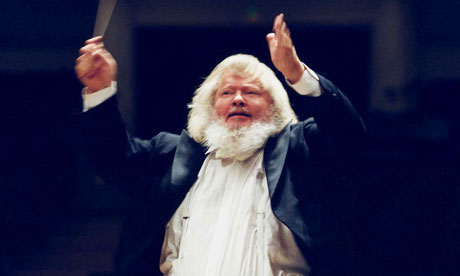 A composer doesn’t need to go to another place. He needs just a piece of paper where he can put down little marks, and as he does that, he can imagine sounds that had not existed before in that particular combination. So once he gets to that point of beginning to create, he enters that different reality. He says that this is so intense an experience that it feels almost as if he didn’t exist.
When you are really involved in this completely engaging process of creating something new, as the composer is, he doesn’t have enough attention left over to monitor how his body feels, or his problems at home. He can’t feel even that he’s hungry or tired. His body disappears; his identity disappears from his consciousness, because he doesn’t have enough attention to really do something that requires a lot of concentration, and at the same time to feel that he exists. So existence is temporarily suspended. And he says that his hand seems to be moving by itself.
So what it’s telling you here is that obviously this automatic, spontaneous process that he’s describing can only happen to someone who is very well trained and who has developed technique. And it has become a kind of a truism in the study of creativity that you can’t be creating anything with less than 10 years of technical-knowledge immersion in a particular field. Whether its mathematics or music, it takes that long to be able to begin to change something in a way that it’s better than what was there before. Now, when that happens, he says the music just flows out. So many of the people I interviewed described this as a spontaneous flow that I decided to call this type of experience the “flow experience.” And it happens in different realms.
Leading writers and poets in the United States describes the same effortless, spontaneous feeling that you get when you enter into this ecstatic state. The poet describes it as opening a door that floats in the sky — a very similar description to what Albert Einstein gave as to how he imagined the forces of relativity, when he was struggling with trying to understand how it worked. But it happens.
Regardless of the culture, regardless of education or whatever there are conditions that seem to be there when a person is in flow. There’s this focus that, once it becomes intense, leads to a sense of ecstasy, a sense of clarity: you know exactly what you want to do from one moment to the other; you get immediate feedback. You know that what you need to do is possible to do, even though difficult, and sense of time disappears, you forget yourself, you feel part of something larger. And once the conditions are present, what you are doing becomes worth doing for its own sake.
So the question we are trying to address is how to put more and more of everyday life in that flow channel. And that is the kind of challenge that we’re trying to understand. And some of you obviously know how to do that spontaneously without any advice, but unfortunately a lot of people don’t. And that’s what our mandate is; to find out.
Csikszentmihalyi is best-known for his theory of flow, which he outlined in his seminal 1990 book Flow: The Psychology of Optimal Experience.For full bio see here
Comments
One response to “Flow: The Secret to Happiness – Mihaly Csikszentmihaly”
[…] most ideal state to function from is a state of complete focus. In this talk Mihaly Csiksczentmihaly called this state of complete focus “flow” and argues that flow […]